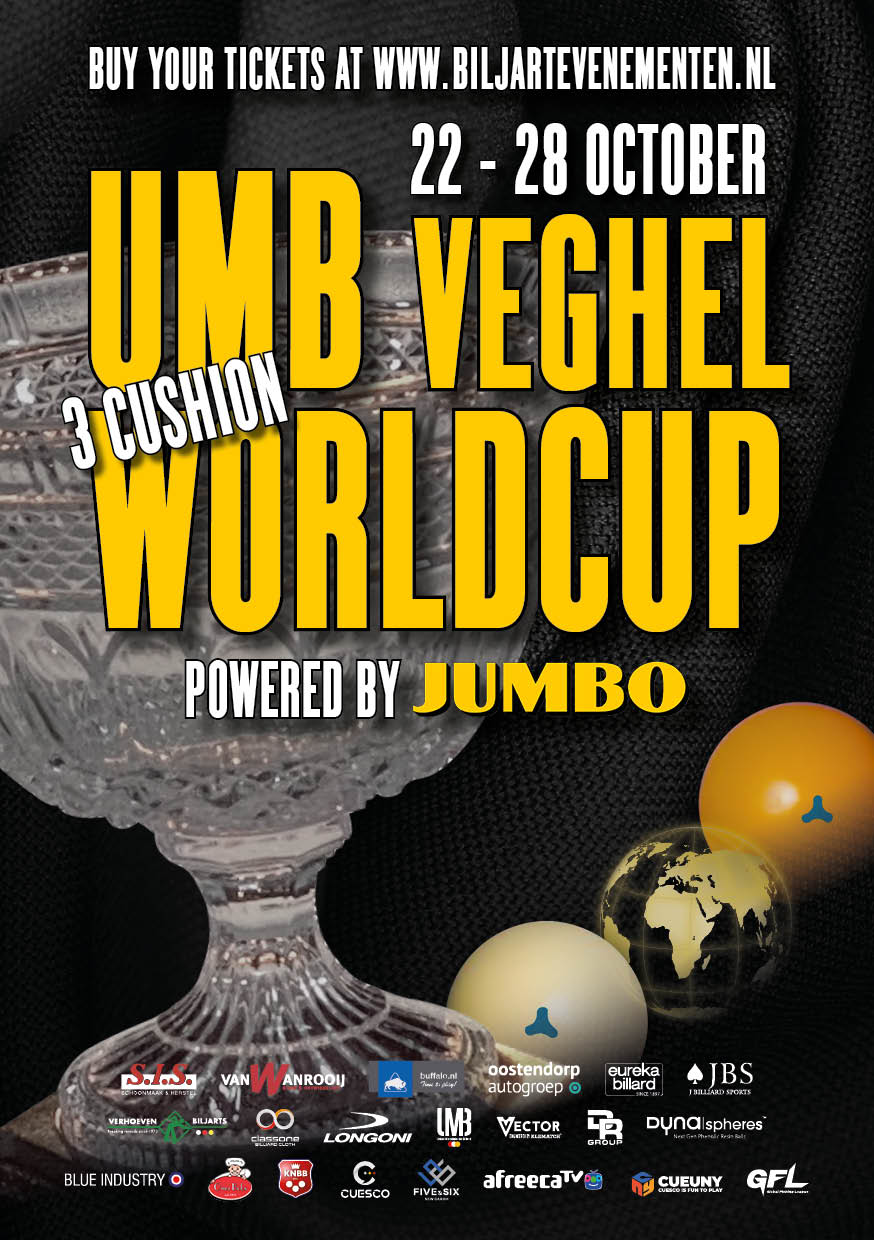





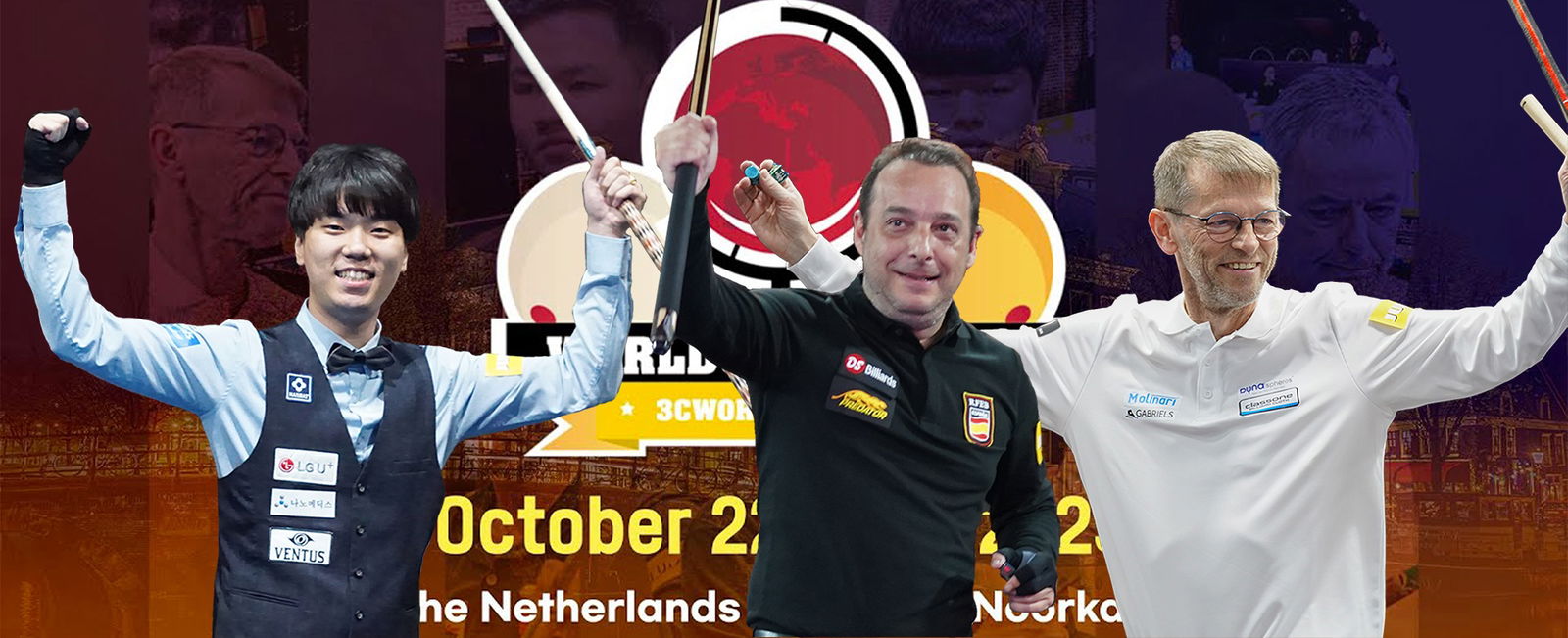
VEGHEL - The World Cup cycle in three-cushion comes to the Netherlands for the 28th time in history this weekend. The most World Cups in the Netherlands were organized by Oosterhout with 10, followed by Sluiskil with five, Valkenburg, Barendrecht and Veghel with three and Roermond, Bussum and Dongen with one World Cup. A total of 196 World Cups have been organized by the UMB since 1986. For the Netherlands, there are 27 World Cups in the list of organizations, Egypt has 22, the Turks 20 World Cups just like the Belgians. The most World Cups worldwide are organized by Hurghada: 12 in total, followed by Porto (11), Oosterhout (10), Berlin (9), Antwerp/Deurne and Antalya (8) and Istanbul (7). It is remarkable how often the World Cup cycle came to a capital city: Berlin (9), Ho Chi Minh City (6), Seoul, Tokyo, Palma (5), Paris (4), Athens, Bogota (3), Lisbon (1), Cairo (1), Brussels (1), Ankara (1), Vienna (1) and Mexico City (1).
Harry Mathijssen has entered the cycle with his organization in Veghel from 2019 and plans to become a regular on the World Cup calendar. In the first three events, the Dutch enclave celebrated Haeng Jik Kim, Dani Sánchez and Torbjörn Blomdahl as winners. Dick Jaspers, just dethroned as the long-time world number one, did not yet manage to win the World Cup in Veghel in his own region.
For the Netherlands, Valkenburg was the forerunner as organizer in 1986, the first year of the World Cups. Japanese Nobuaki Kobayashi won in Valkenburg, that did not return to the calendar afterwards. The Oosterhout organization started its series in 1992 (Rini van Bracht winner) and kept it up until 2001 (Torbjörn Blomdahl).
Harry Mathijssen, who also has plans with a team of friends and relations to organize a World three-cushion championship in one of the coming years, foresees that his Dutch organization in Veghel will by now occupy a regular place on this long list of World Cups. We asked the organizer for a total view at the history and a preview of his World Cup (Sunday 22-Saturday 28 October 2023).
Kozoom/KNBB/Frits Bakker: What does it say for Dutch billiards that it has organized the most World Cups of any country in the world?
Harry Mathijssen: That is a great compliment to the Dutch entrepreneurial spirit. Honestly it surprises me that the Netherlands has such a great and long history in World Cups. What I know about it is that we always do excel at organizing, as I’ve seen myself in the World Cups in Oosterhout and Sluiskil. We, like the billiard players and sponsors in the Netherlands are always enthusiastic about the World Cups. I see it again myself now: a lot of interest from spectators from all corners of the Netherlands, from the deep south to the far north. We have a reputation, that we try to continue.
Kozoom/KNBB/FB: Most World Cups in the Netherlands were in Oosterhout (10). Was that an example for you with Veghel? Did you have a role in Dutch billiards back then?
Harry Mathijssen: That was before my time, although I went there to have a look, also from a business point of view. It was busy and sociable there. I got the virus in those years, it was the start of my career in billiards, when nobody knew me yet. In the later years, I got in touch with the people of Oosterhout, when we first started organizing the Masters.
FB: The main countries for organizing World Cups now are Turkey, Korea, Vietnam, Portugal, but also still the Netherlands. It is a small group of organizers, what is the reason for that?
Harry Mathijssen: It has to do with the federations in these countries and individual organizers. The Korean federation organizes itself, the Turks too, maybe also in Vietnam. We in our countries, like the Netherlands, Belgium France, but also Portugal organize more from individual billiards fans and people who like to organize. Like us with our team in Veghel, Jorge Alipio in Portugal, Kurt Ceulemans in Belgium, Xavier Carrer and Joël Switala in France. It is remarkable that Spain, a main billiard country after all, has not organized for so long. I know there has been a rift with UMB and PBA, but as an organizer you have to be independent. You should not get involved in politics.
FB: What is most attractive for you and for the Netherlands to organize a World Cup?
Harry Mathijssen: Our way of organizing a World Cup is different from, let’s say, Korea or Vietnam, maybe even Turkey, where the events are usually played in large sports centers. We prefere atmosphere and cosiness, lots of entourage around billiards, with good catering and restaurants to offer people a nice day besides billiards. That is often a driving force for us. It also means, though, that it is the most expensive way to organize a World Cup, so you need more sponsors for that. When you get to the faraway countries, there are booths of billiard companies and advertisers. People play billiards, but when it's finished, everyone leaves quickly. I don't want to say that with us people stay late into the evening, but there is more commotion, conviviality and ambiance. It feels great for us to be able to organize a World Cup.
FB: Also sports-wise, with Dick Jaspers and Therese Klompenhouwer as long-time major champions: why is the Netherlands such a prominent country in global three-cushion?
Harry Mathijssen: Dick Jaspers and Therese Klompenhouwer are phenomena, who are idolized by their sport and live entirely for it. Fantastic sportsmen who have made it to the top of the world thanks to talent and great commitment, who are obsessed with the game and with performing. I have a deep respect for both of them. What is the reason? I think the premier league for teams has helped that. In the early years, the Netherlands had the best team competition in the world with players like Blomdahl, Sánchez, Jaspers, Caudron, Zanetti, Merckx and even Ceulemans. Dutch billiards was able to work its way up, partly because of this: there was great competition within the teams, you could play against the world's top players every week and see the world's top players play. All those pros made Dutch billiards great. The players were shaped and grew by that high level.
FB: What does organizing a World Cup depend on: a big sponsor like Jumbo, which is also known from a famous cycling team and from Formule 1 racing with Max Verstappen?
Harry Mathijssen: You can put it this way: no Jumbo, no World Cup. We have this sponsor since 2016 and until 2024. That has put us on the road to big organizations like the World Cups. It is a sponsor where winning, getting bigger and bigger and getting better is in the DNA. We were happy to go along with that. We are dependent on it and indeed, if Jumbo will stop after 2024, we have to look for another big lender. So we are now on the calendar with our World Cup basically until 2024.
FB: What do you think of the UMB system of participating in a World Cup? So, a group of seeded players, of players who get preference to enter because of their ranking, just over 20 players from the country and for a big group of unknown players: first come, first in. That even creates a reserve list of some 80 to 100 players.
Harry Mathijssen: It works perfectly, I wouldn't know how it could be better. There are 27 Dutchmen in a total of 149 players allowed to compete. If you wanted to increase the quality, there could be fewer Dutch players. But I think it is good as it is now. It is a very good and watertight system, also with the wildcards an organization is allowed to hand out. The UMB now gives juniors a chance by organizing championships and tournaments and does a lot more for women's billiards. I can't say a bad word about it.
FB: How do you look qualitatively at the World Cup cycle? In recent years, a number of top players have left UMB for a more lucrative stay at the PBA. Surely that means a devaluation for the World Cups?
Harry Mathijssen: Yes indeed, it is a devaluation, because a few superstars have left. For the image of the World Cups, it is very unfortunate and for the billiard audience to come and watch these famous players. But don't forget that at UMB we still kept a lot of great players of a very high level. The most famous champions have remained loyal to UMB. I don't have the feeling that the PBA now gives such a huge boost to global billiards. You do see players returning every year for whom apparently the money they earn does not outweigh the travelling and spending months in Korea. The announcement that PBA would conquer Europe as well has not materialized, so these plans have all failed. It’s really good that UMB runs its own course. I don't blame players for making the switch and wanting to make money at the PBA, but the fact that many have already come back, even after just one or two years, means they are doing well there. It is what it is, we have learnt to deal with it. What is good, as a result, is that the UMB has also scaled up the prize money further. The world champion will earn 40,000 euros from next year instead of 20,000 this year. These are good increases, although there is still room for improvement. A tennis player who wins an ATP tournament gets 200,000 euros. That's half more than the entire prize money of the World Cup in Veghel. So we have a lot of catching up to do on other sports.
FB: Finally: are there any plans in the Netherlands to organize a World championship in three cushion in the next two years?
Harry Mathijssen: I'm actually not allowed to say much about it yet, but behind the scenes a group of people are working on it. The ambitions are alive for some years: organizing World Cups and even bringing a World Championship to the Netherlands again. The plans are there, people from billiards world are involved. It could bring new impulses to Dutch billiards.
Thanks, Harry Mathijssen, good luck with the upcoming World Cup in Veghel.
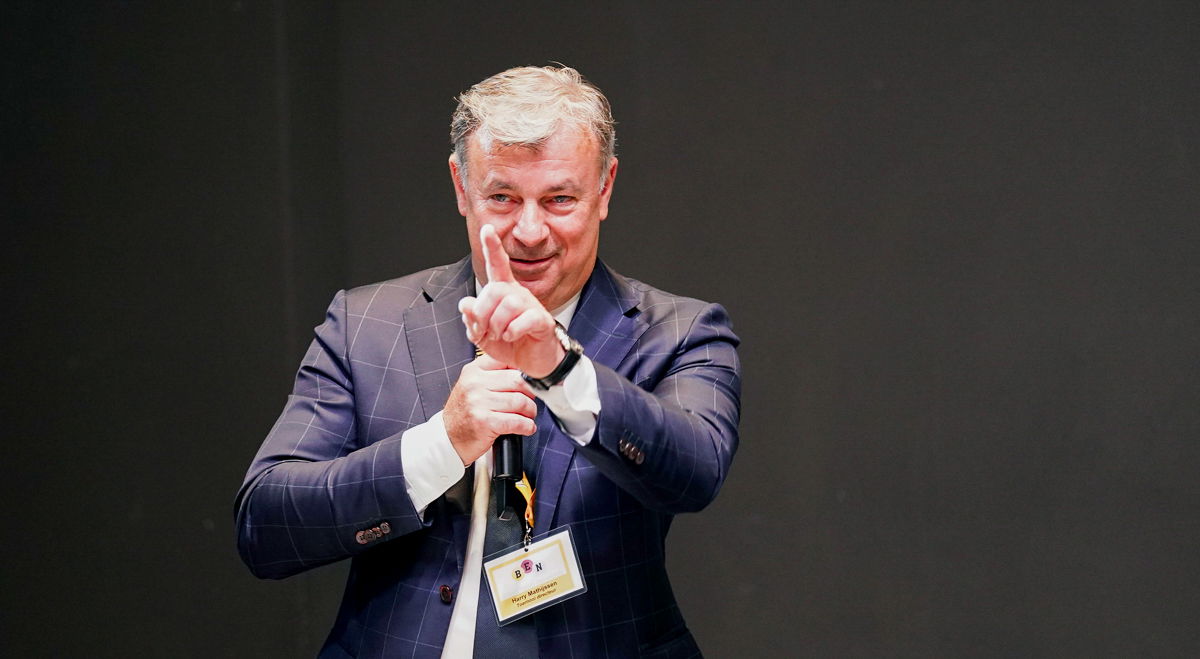 Harry Mathijssen, the World Cup organizer in Veghel
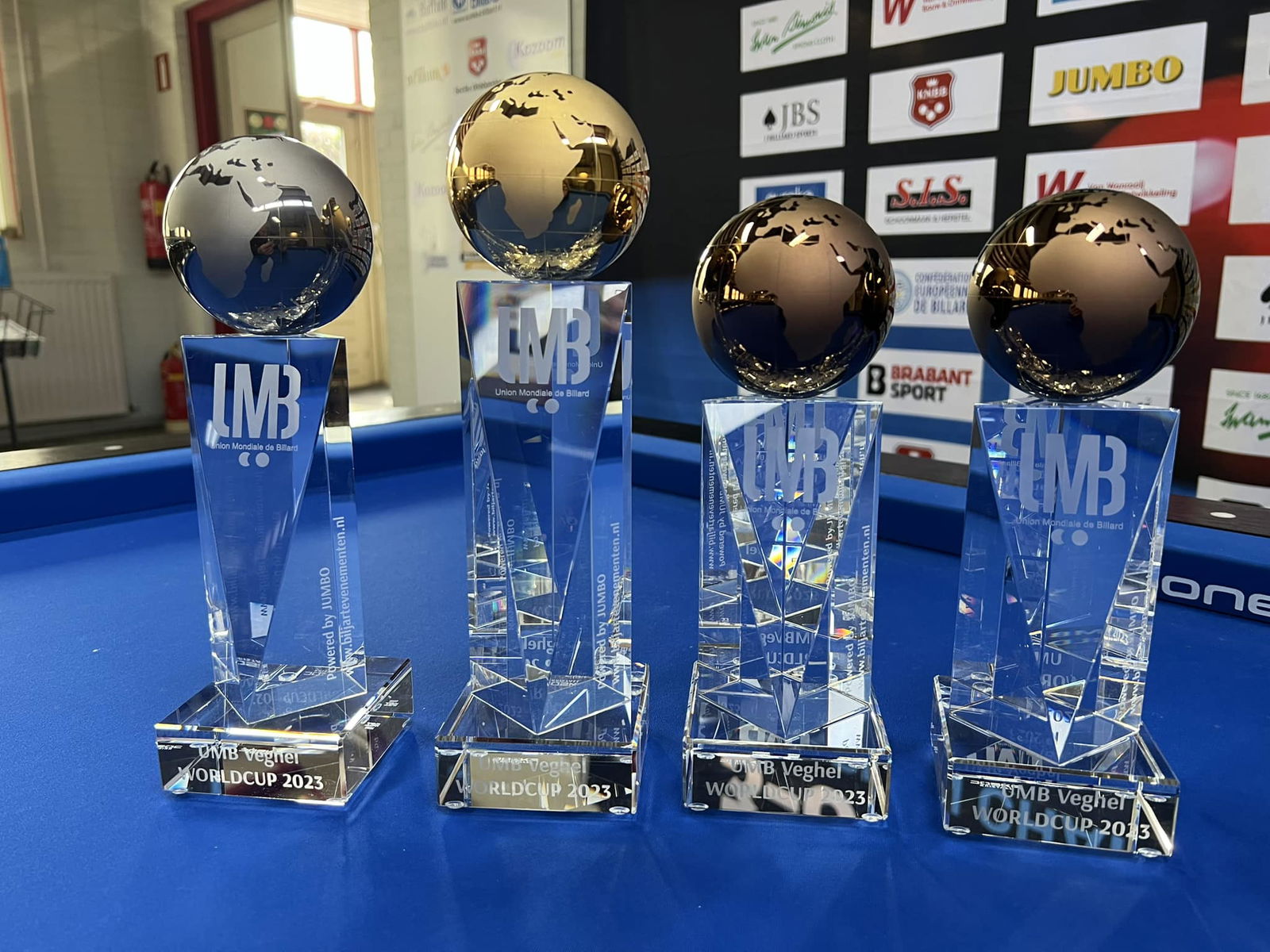 The World Cup trophies for Veghel